
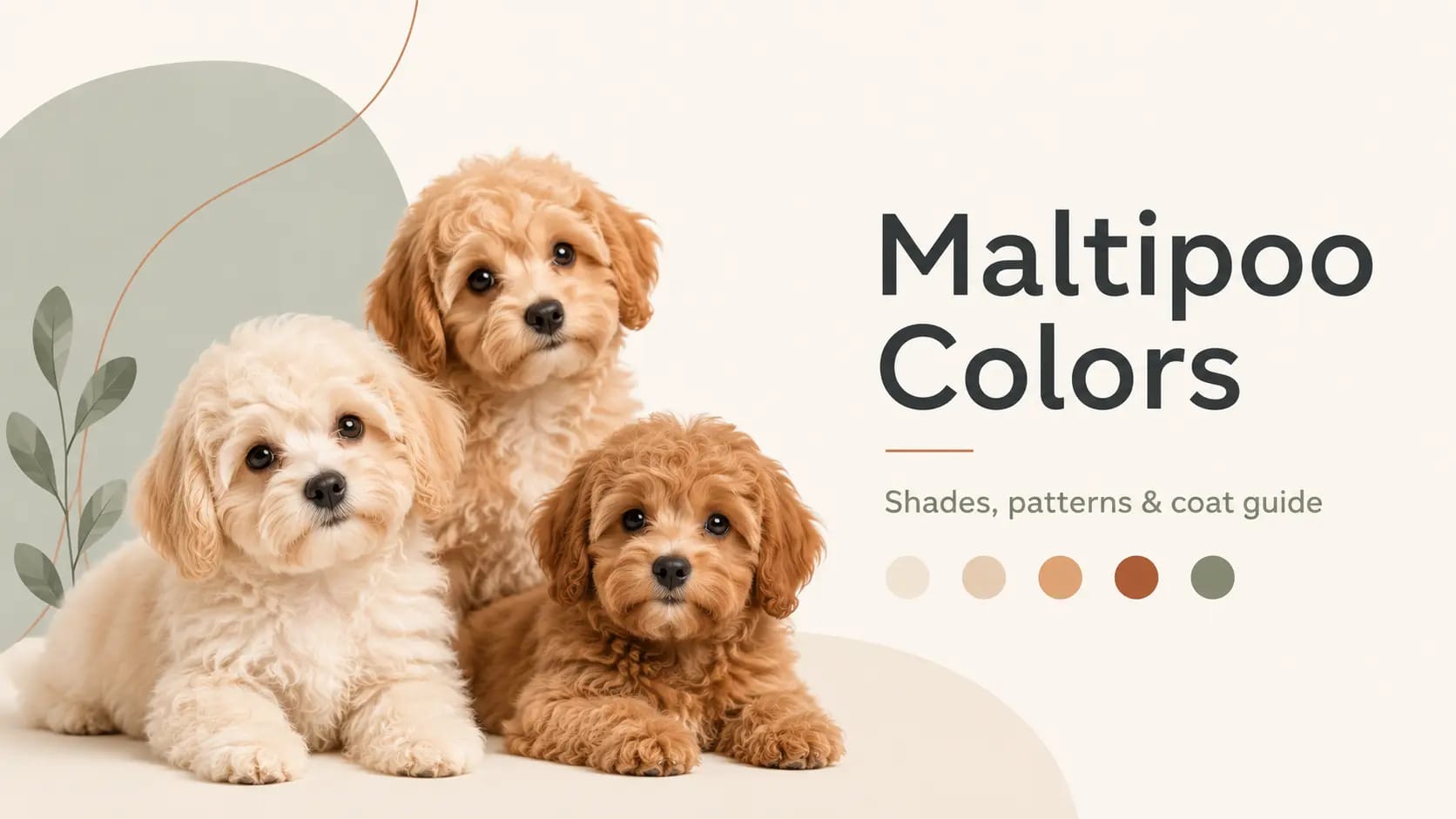
Maltipoos come in a wide range of colors, from bright white and warm cream to deep red, chocolate brown, silver grey, and solid black. White and cream are the most common. Solid black is the rarest.
One thing every potential owner should know before choosing a puppy: many Maltipoos are born one color and grow into a noticeably different one by adulthood. That is not unusual or a sign of anything wrong. It is genetics, and it is worth understanding before you fall in love with a dark puppy that may look quite different at two years old.
Maltipoo colors at a glance
| Color | How common | What to expect |
|---|---|---|
| White | Very common | The classic Maltipoo look, from the Maltese side. Stays white, but can show tear stains. |
| Cream | Very common | Warm, soft tone. May be born very pale or slightly golden and stay consistent. |
| Apricot | Very common | Warm peachy-gold. One of the most popular colors. Often fades lighter with age. |
| Red | Less common | Deep, rich tone. Usually fades toward apricot or cream over time. |
| Brown / Chocolate | Less common | True brown is harder to breed. Can fade to lighter tan or beige. |
| Grey / Silver | Less common | Often born darker and lightens progressively through puppyhood and young adulthood. |
| Black | Rare | The rarest solid color. Many fade to silver or grey. Solid black that holds is uncommon. |
| Sable | Uncommon | Black-tipped hairs over a lighter base. Usually lightens and softens with age. |
Where Maltipoo colors come from
The Maltese and the Poodle bring very different color palettes to the mix.
The Maltese is almost exclusively white. That is where the white and cream Maltipoos come from. It is also why lighter coats are the most common outcome in first-generation crossings.
The Poodle side adds far more variety. Poodles come in black, white, apricot, red, cream, silver, grey, brown, cafe-au-lait, and blue, among others. The more Poodle genetics a dog carries, the wider the range of possible colors. An F1B Maltipoo (roughly 75 percent Poodle) is more likely to carry darker or more vivid colors than a first-generation F1, which has equal parts Maltese and Poodle.
The most common Maltipoo colors
White: The simplest and most common color to produce, because the Maltese parent almost always contributes white genes. White Maltipoos often look like soft clouds of fluff. The main grooming note is tear staining, the reddish-brown marks that can appear beneath the eyes, which shows more on a pale coat and needs regular wiping.
Cream: A warm, slightly golden white. Cream and white Maltipoos are often confused with each other, and many fall somewhere between the two. Cream tends to be stable and does not fade dramatically.
Apricot: The most popular color after white and cream. Apricot is a warm peachy-gold that comes from the Poodle side and ranges from a soft blush tone to a deeper golden orange. It is one of the most sought-after colors and very widely available.
Less common Maltipoo colors
Red: A deeper, richer version of apricot. True red Maltipoos are beautiful but require specific genetics from the Poodle side, and red coats tend to fade. A puppy that looks deep red at eight weeks may be apricot or light tan by the time it reaches two years old. If you want a red Maltipoo, ask the breeder about the parent dogs' color stability.
Brown and chocolate: True chocolate Maltipoos do exist but are genuinely less common. The brown gene needs to come through on the Poodle side, and the Maltese's dominant light genes often dilute it. Brown coats also tend to fade, sometimes to a lighter tan or beige. F1B and later generations with more Poodle genetics are more likely to produce and hold a brown coat.
Grey and silver: Grey Maltipoos are often born looking nearly black or dark charcoal and lighten gradually over the first one to two years. This is a normal and predictable color progression tied to the progressive graying gene from the Poodle side. A dog that looks dark at eight weeks may be a clear silver-grey by eighteen months.
The rarest Maltipoo colors
Solid black: Producing a truly solid black Maltipoo requires a black Poodle parent with a strong history of producing dark puppies, plus the right genetics from the Maltese side. Even then, many dogs that appear solid black as puppies develop white hairs or fade to a dark silver or grey as the adult coat comes in. A Maltipoo that holds a true, stable black coat through adulthood is uncommon.
Sable: A sable coat has dark-tipped hairs, usually black, over a lighter base that can range from cream to gold to tan. The overall effect shifts dramatically with age as the dark tips fade or shed out, often leaving a much lighter dog underneath. Sable puppies can be striking but are difficult to predict in their final adult appearance.
Maltipoo coat patterns
Most Maltipoos are solid in color, but several pattern types also appear:
Parti: Two distinct color areas, usually white combined with another color like apricot, brown, or black. The white tends to be the majority color.
Tricolor: Three colors present, often white, black or brown, and tan. Less common than parti.
Phantom: A specific marking pattern where a contrasting color appears on defined areas: above the eyes, on the sides of the muzzle, on the chest, inside the legs, and under the tail. Phantom markings come from the Poodle side and are similar to the coloring of a Doberman.
Merle: A mottled, dappled pattern with irregular patches of diluted color. Merle Maltipoos do exist, but this pattern requires careful ethical breeding. Two merle-to-merle breedings can produce puppies with serious health problems, including blindness and deafness. If you are considering a merle Maltipoo, choose a breeder who does full genetic testing and never breeds two merle dogs together.
Will your Maltipoo's color change?
Many will, and it is one of the most common surprises for new owners.
The Poodle carries what is known as the progressive graying gene, or fading gene. Dogs that inherit this gene are born with a darker or more vivid color and gradually lighten as they mature. The process typically takes one to two years, with the most noticeable changes happening between three and eighteen months.
Common color progressions:
- Deep red at 8 weeks may become apricot by 18 months
- Dark apricot may soften to cream
- Black or very dark puppies may become silver or grey
- Sable puppies often lose most of their dark tipping and look much lighter as adults
There is nothing you can do to prevent fading if the gene is present. It is entirely genetic. If holding a specific color matters to you, ask the breeder whether the parents carry the fading gene and look at photos of past litters as adults, not just as puppies.
Colors that tend to hold most reliably: white and cream. They have little to fade to begin with.
Does color affect personality or health?
No. A Maltipoo's coat color does not influence its temperament, trainability, or general health. An apricot Maltipoo and a black Maltipoo from the same litter will have the same fundamental personality traits.
The one partial exception is merle. Merle dogs that are double-merle (the result of two merle parents breeding) carry a higher risk of eye and hearing abnormalities. That is a breeding ethics issue, not a color issue, and is easily avoided by choosing a responsible breeder.
Color can affect one grooming factor: lighter coats, especially white, show tear stains more visibly and may need more regular face-wiping. Beyond that, choose the color you love. See our Maltipoo grooming guide for coat care by color type.
Choosing a puppy: a note on color
Color is one of the first things people notice in a puppy, and it is completely reasonable to have a preference. Just do not let it be the only factor.
A Maltipoo's temperament, the health testing of the parent dogs, and the ethics and transparency of the breeder matter far more than coat color to the quality of life you will both have together. A good breeder will show you health clearances for both parents and let you see where the puppies were raised. If a breeder is charging significantly more for a “rare” color without those basics in place, that is a warning sign.
And remember: the puppy in the photos may look quite different by the time it is two.