
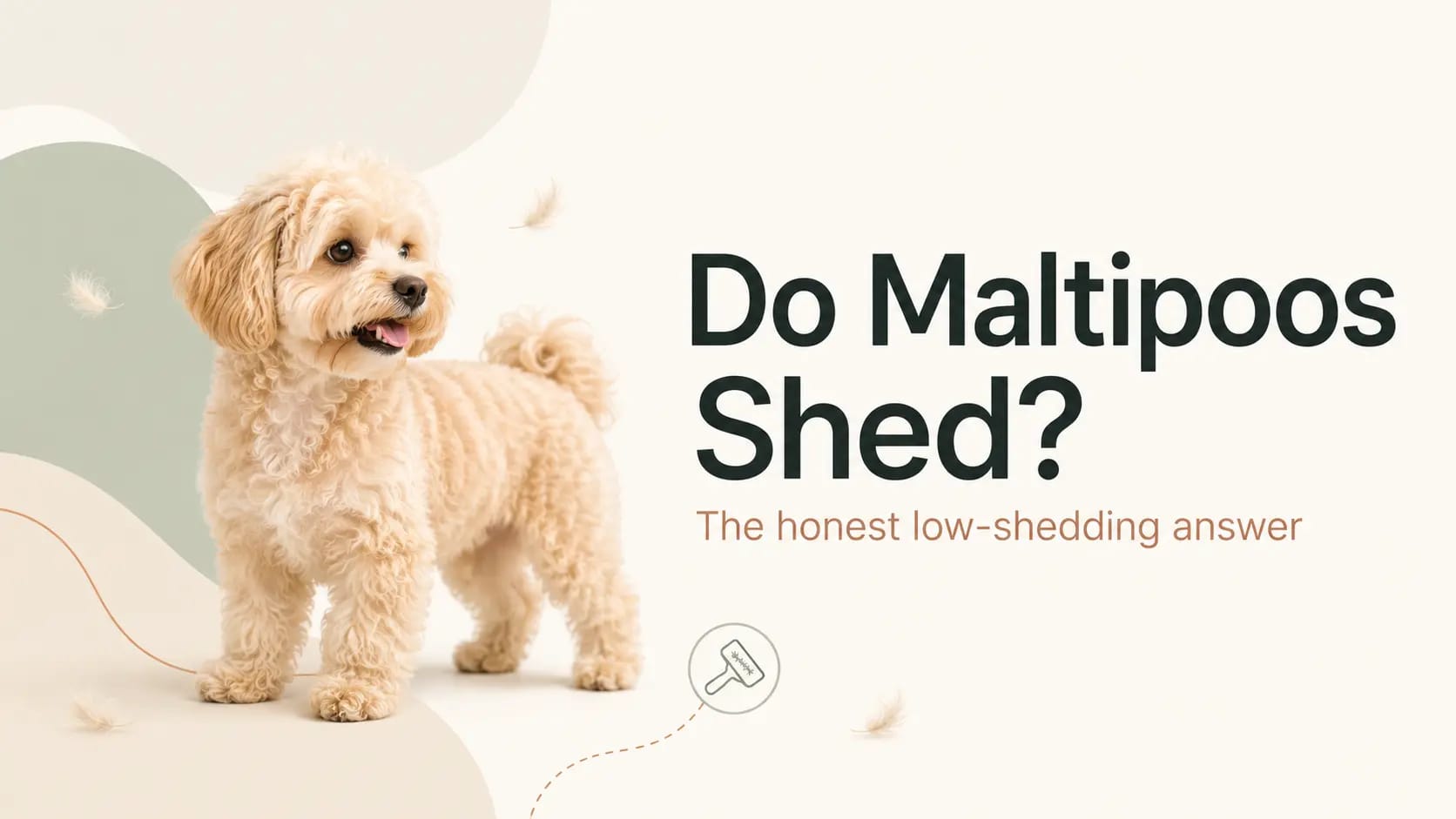
Yes, Maltipoos shed, but very little. You will lose a few stray hairs here and there, the kind you notice on a dark sweater after a cuddle, but you will not find clumps of hair on the couch or tufts drifting across the floor. Compared with most dogs, a Maltipoo is about as low-shedding as it gets.
That low shedding comes with one catch most owners do not expect, and it has nothing to do with allergies. We will get to it below.
At a glance
| Your question | The short answer |
|---|---|
| Do Maltipoos shed? | Yes, but very lightly. Most of the time you will barely notice it. |
| Why so little? | Both parent breeds, the Maltese and the Poodle, have a single-layer coat that holds onto loose hair instead of dropping it. |
| Are they hypoallergenic? | No dog truly is, but a low-shedding Maltipoo is one of the better choices for allergy-prone homes. |
| Does coat type matter? | Yes. Curlier coats trap more loose hair and dander. Straighter coats can look like they shed a little more. |
| Do puppies shed more? | They lose their soft puppy coat around 6 to 10 months, then settle into steady, minimal shedding. |
| The catch? | Loose hair gets trapped in the coat, so without regular brushing it mats. |
Do Maltipoos shed a lot?
No. A Maltipoo is a light shedder, and many owners say they go days without finding a single hair. You will see the occasional strand on your clothes or in the dog bed, but nothing like the seasonal “blowout” you get from a Labrador or a Husky.
Here is the honest part: low-shedding is not no-shedding. Every dog with hair loses some of it, the same way you lose a few strands when you brush. A Maltipoo just sheds far less than average, and most of what it does shed stays caught in the coat rather than landing on your floor.
Why do Maltipoos shed so little?
It comes down to the coat the Maltipoo inherits from both parents.
A Maltipoo is a cross between a Maltese and a toy or miniature Poodle. Both of those breeds have a single-layer coat, also called a single coat. Many heavy shedders, like Labs and German Shepherds, have a double coat: a soft, dense undercoat under a top layer. That undercoat is what sheds in large amounts, especially when the seasons change. Maltipoos do not have one.
There is a second reason. The Maltese and the Poodle both grow hair rather than fur. Hair grows in longer cycles and sheds slowly. Fur grows in short cycles and sheds constantly. The Poodle's curly coat in particular tends to hold loose hairs inside the curl instead of letting them fall, which is a big part of why poodle mixes earned their low-shedding reputation in the first place.
Put those two traits together, a single layer plus a slow-shedding hair coat, and you get a dog that sheds about as little as a dog can.
Does coat type change how much a Maltipoo sheds?
It does, a little. Maltipoo coats usually fall into three rough types, and the type your dog ends up with affects both shedding and grooming.
- Curly coat. More like the Poodle parent. Curls trap loose hair and dander most effectively, so you see the least shedding. The trade-off is that this coat mats the fastest and needs the most brushing.
- Wavy coat. A blend of both parents and the most common type. It sheds very lightly and sits in the middle for grooming effort. Many people call this the classic “teddy bear” look.
- Straight or silky coat. More like the Maltese parent. It can look like it sheds a touch more, simply because loose hairs fall free instead of getting caught, but the actual amount is still small.
You will also see breeders talk about generations, like F1 (a Maltese crossed with a Poodle) or F1B (an F1 Maltipoo crossed back to a Poodle, so roughly 75 percent Poodle). An F1B often has a curlier, lower-shedding coat because it carries more Poodle genetics. That said, because both parent breeds are already single-coated and low-shedding, the difference between generations is usually small, not dramatic.
For a full breakdown of how these coats look and the colors they come in, see our Maltipoo colors and coat guide.
Do Maltipoo puppies shed more than adults?
There is one stage where you might notice more hair: the move from puppy coat to adult coat.
Maltipoo puppies are born with a soft, fluffy coat. Somewhere around 6 to 10 months, that puppy coat starts to give way to the coarser adult coat. During this transition you may see a bit more loose hair than usual, and the coat can go through an awkward, easily-matted phase. This is normal and temporary. Brush a little more often during these months to stay ahead of tangles. Once the adult coat is in, shedding settles back down to its usual light, steady level.
Are Maltipoos hypoallergenic?
This is the question behind most “do Maltipoos shed” searches, so here is the straight answer: no dog is truly hypoallergenic, including the Maltipoo. But a low-shedding Maltipoo is still one of the more allergy-friendly dogs you can choose.
The reason matters. Most people are not allergic to dog hair itself. They react to proteins in dander (dead skin flakes), saliva, and urine. According to the American College of Allergy, Asthma and Immunology, every dog produces these allergens, and research has not found a breed that reliably avoids them. The American Kennel Club points to the same 2011 study, which found no meaningful difference in household allergen levels between homes with so-called hypoallergenic dogs and homes with other breeds.
So why are Maltipoos still a popular pick for allergy-prone homes? Because shedding is how dander spreads. A heavy shedder scatters hair, and the dander stuck to it, across every surface in the house. A Maltipoo sheds far less, so less of that allergen-carrying hair ends up on your floors, furniture, and clothes. Curlier coats help even more, since they hold dander in the coat until you wash or brush it out.
The practical takeaway: a Maltipoo will not guarantee an allergy-free home, but it gives a sensitive person a real fighting chance. If allergies are a concern, spend time around a Maltipoo before you commit, ideally one with the coat type you are considering, and see how you react. Talking to an allergist first is a smart move too.
The catch with a low-shedding coat: matting
Here is the surprise for new owners. The same trait that keeps your floors clean creates the biggest grooming job.
When a dog sheds normally, loose hair simply falls away. A Maltipoo's coat traps that loose hair instead. If it is not brushed out, the trapped hair tangles with the growing coat and forms mats, dense knots that pull on the skin and can hurt your dog. Left long enough, mats trap moisture and debris against the skin and lead to irritation or infection.
So the low-shedding coat does not mean low-maintenance. It means the maintenance shifts from vacuuming your house to brushing your dog. Plan on brushing a few times a week, more for a curly coat, and regular trips to the groomer. Our full Maltipoo grooming guide walks through how to do this without a fight.
How to manage Maltipoo shedding and keep allergens down
A simple routine keeps the loose hair under control and the dander to a minimum:
- Brush several times a week. This is the single most important habit. It pulls trapped hair out of the coat before it can mat and removes dander at the same time. A curly coat may need daily attention.
- Bathe every 3 to 4 weeks. A gentle dog shampoo washes away accumulated dander and loose hair. Do not over-bathe, which dries the skin and can make flaking worse.
- Keep the coat short if allergies are an issue. A short “teddy bear” trim holds less dander than a long coat and is far easier to keep tangle-free.
- Wipe down after walks. A damp cloth over the coat removes pollen and outdoor allergens your dog carries back inside.
- Feed a quality diet. Food with healthy omega fatty acids supports skin and coat, which helps keep shedding minimal and the skin from flaking.
- Use a HEPA filter and vacuum. For allergy-prone households, a HEPA air filter and regular vacuuming pick up the dander that does make it into the home.
When shedding is a sign of something wrong
A sudden change is the thing to watch. If your normally low-shedding Maltipoo starts losing noticeably more hair, develops bald patches, or shows redness, scratching, or flaky skin, that is not normal shedding. It can point to food or environmental allergies, parasites like fleas or mites, a thyroid issue, or stress.
When you see those signs, book a vet visit rather than reaching for a new shampoo. Heavy or patchy hair loss is a symptom, and the fix depends on the cause.